
Agent autonomy has a pricing problem
34% of professional developers say unpredictable task cost limits how much autonomy they give AI agents. How metered pricing shapes vendor choice.
Independent research on how AI is reshaping software development, built on 20 years of surveying developers. Read our latest findings on AI developer tools and agents, AI ROI, open models and cloud native development.
The complete analysis behind each survey wave, with the sample stated on every chart.
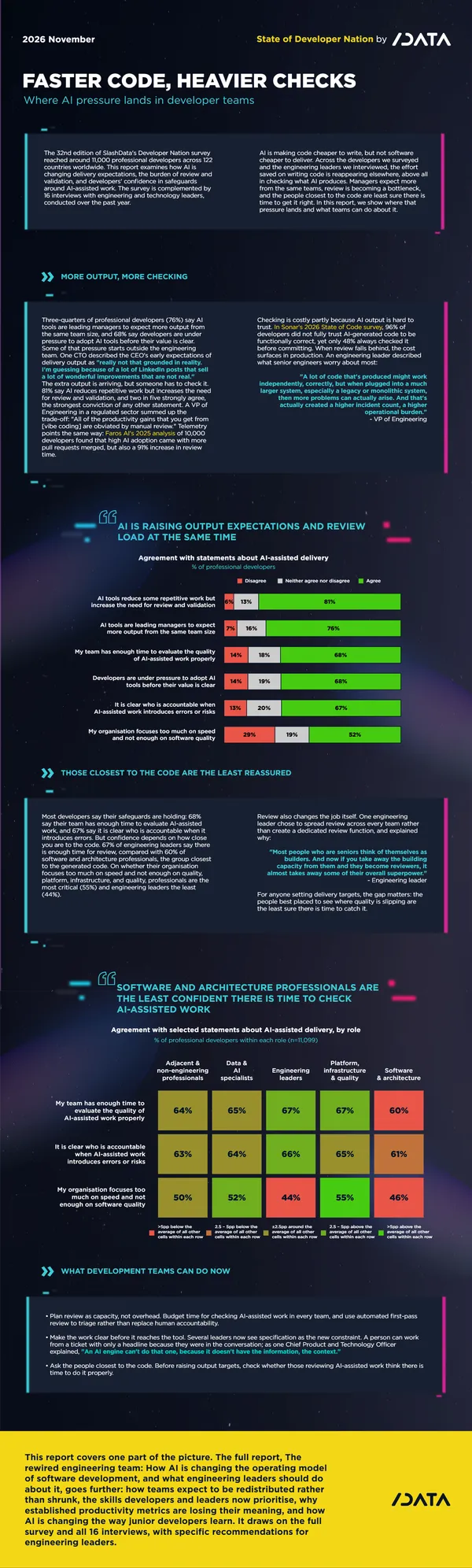
Three-quarters of professional developers (76%) say AI tools are leading managers to expect more output from the same team size.
There are 16M-22M active builders today: people building software without knowing how to code.
Among practitioners using hands-on labs, 63% report that developers are fully productive within two months or less, compared to 42% among those who do not.
For organisations that made changes to their cloud infrastructure over the last year, 31% of developers moved services from on-premise to public cloud, compared to 28% and 24% who moved from public cloud to private cloud and on-premise infrastructure, respectively.
88% of professional developers work with AI models, tools, APIs, or services.
Code generation is the most common task developers report using AI for, with almost half (49%) of those using AI assistants doing so for this purpose.
JavaScript continues to hold the top spot with 27.3M developers worldwide.
88% of technology leaders say they currently measure the impact or ROI of the AI tools, models, or services their teams use, but only 39% are measuring AI impact through formal or automated processes.
The most common approach to internal platforms among respondents was having multiple teams collaboratively handle platform capabilities (41%).
YouTube dominates the learning landscape, with 62% of developers who use social media selecting it as one of their preferred platforms for this purpose.
There were 19.9M cloud native developers globally in Q1 2026, roughly 39% of the entire global developer population.
No. We reach out to the global developer population afresh in each wave, so the results represent the many different communities, backgrounds and projects out there.
We check for speeding and straightlining, run advanced bot and VPN detection, and build consistency checks around most questions. For example, a respondent who says they use React but also says they cannot code is caught by these checks.
In some projects, yes. If one group, such as a region, brings a disproportionate share of the sample, we weight the data across several attributes to reduce that bias.
Each report on this page states its sample, so you can see how many developers the finding rests on before you use it.
This page lists every free report, newest first, and the latest blog posts. The link at the end of the blog section takes you to every post.
The headline number and what it means, in a few minutes of reading.
34% of professional developers say unpredictable task cost limits how much autonomy they give AI agents. How metered pricing shapes vendor choice.

62% of senior developers save time with AI coding tools, against 42% of juniors. This piece examines how ROI is measured and the risk to junior hiring.

A recurring research programme gives CTOs and VPs of Engineering an independent benchmark on AI ROI, team structure and the decisions reshaping software teams.
